
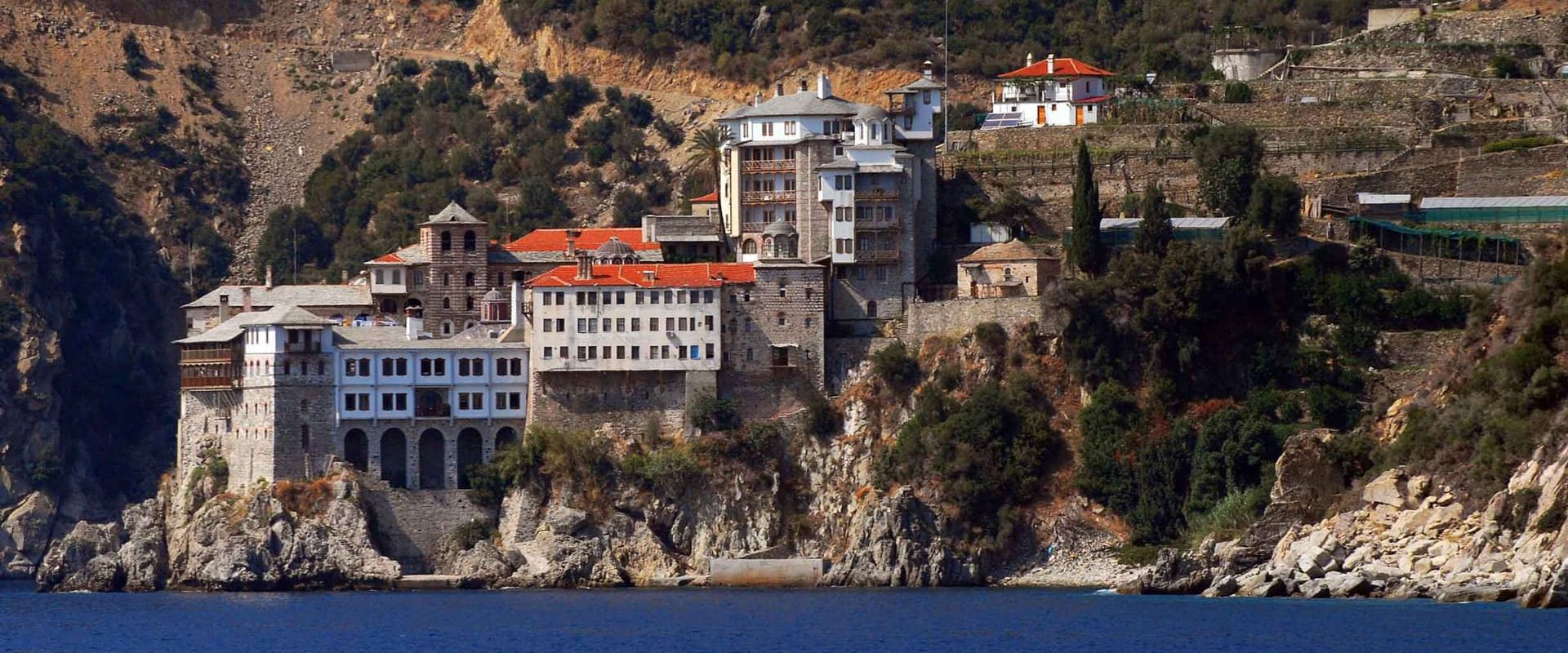
The Mount Athos
The Mount Athos. One of the most important sites for the Orthodox faith! 20 monasteries lie there making the peninsula of Athos unique to all over the world!
* The peninsula of Athos is the eastern and rougher of all three elongated parallel peninsulas (Kassandra or Pallini, Logkos or Sithonia- central, and Athos or Holy Mountain) that comprise the peninsula of Chalkidiki. This peninsula is covered by Mount Athos, as high as 2033m, hence its name, which ends to the cape of Nymfaio or Akrathos. It is devoid of rivers and lakes. It is linked with Chalkidiki with the narrow strait of Xerxes, a low stretch 2klm long, which is historical due to the Persian wars in 480BC. Between the peninsula of Athos and Sithonia or Logkos the Sigitikos is formed by the gulf of the Holy Mountain while to the NE there is Ierissos gulf. Some miles to the SE of Athos there is the biggest chasm of the Aegean which starting from a depth of 80m it reaches the depth of 1070m.
The predominance of the name “Holy Mountain” seems to have happened during the first half of the 12th century, more specifically with a golden bull “chrysobull” document of the Emperor Alexios I Komnenos to the Monastery of Megisti Lavra in 1144, which recognized permanently and officially as well as imposed the new name as it is mentioned in it. “From now on the name of Athos should be Holy Mountain for everybody”. According to the Greek Mythology, the mountain Athos was linked with the fight of Giants, Giants against the Olympian Gods, and Athos was the leader of the former. Athos threw a huge rock from Thace against Poseidon but he missed and the rock fell in the sea creating a mountain, which was given his name.
Diamonitirion “Visitors’ permit”: It is an obligation of whoever wishes to visit the Holy Mountain to have this special permit from the Holy Mount Athos Pilgrim’s Bureau in Thessaloniki and Ouranoupoli, Chalkidiki. The special stamp, which must be attached to the diamonitirion in order for it to be valid currently costs €25,00 for Orthodox Christians, €35,00 for non-orthodox Christians and people of other religions and €10,00 for special categories (students and soldiers).
The Holy Monasteries: The Holy Mountain consists of 20 Holy Monasteries. According to the hierarchical order the Holy Monasteries of the Holy Mountain, also called as Athonic, which are self managed according to their internal rule, which they vote and the Holy Community approves, are the following:
- Monastery Megistis Lavras (963)
- Monastery Vatopediou (972)
- Monastery Iviron (976)[46]
- Monastery Hilandar (1197, Serbian)
- Monastery Agios Dionisiou (1375)
- Monastery Koutloumousiou (12th century)
- Monastery Pandokratoros (1363)
- Monastery Xiropotamou (11th century)
- Monastery Zografou (919, Bulgarian)
- Monastery Dochiariou (11th century)
- Monastery Karakallou(1070)
- Monastery Filotheou (992)
- Monastery Simonos Petras (1363)
- Monastery Agios Pavlou (11st century)
- Monastery Stavronikita(1542)
- Monastery Xenofondos(1070)
- Monastery Grigoriou (14th century)
- Monastery Esfigmenou (11th century)
- Monastery of Agios Panteleimon 11th century, Russian) [47]
- Monastery Konstamonitou (1086)
* Source Wikipedia